Human-Centric Operations & Aliens R&D Vitalization Solutions
Life beyond Earth is a transition from terrestrial biological norms to a
technologically mediated existence. Sustaining life in deep space—exemplified by
the upcoming Lunar Gateway—requires more than life support; it requires the
engineering of community, privacy, and physiological resilience.
- The Human Element in Microgravity
Current habitation concepts, such as the International Habitation Module (I-HAB),
address the spatial limitations of zero gravity through meticulous architectural
planning. Key considerations include:
Communal Dynamics: Shared spaces for meals and gatherings are
essential for fostering camaraderie and preventing psychological isolation
in international crews.
Privacy vs. Utility: Deployable crew quarters and compact hygiene facilities
must balance the need for personal privacy with the extreme spatial
constraints of modular stations.
Beyond the Van Allen Belt: Future lunar observatories face novel
challenges, including heightened radiation exposure and the requirement
for constant Earth-Moon communication. - Aliens R&D: Vitalization Solutions
At Aliens R&D, we focus on the “Vitalization” of space habitats—ensuring they are
not just survivable, but thriveable.
I. Biophilic Habitat Vitalization
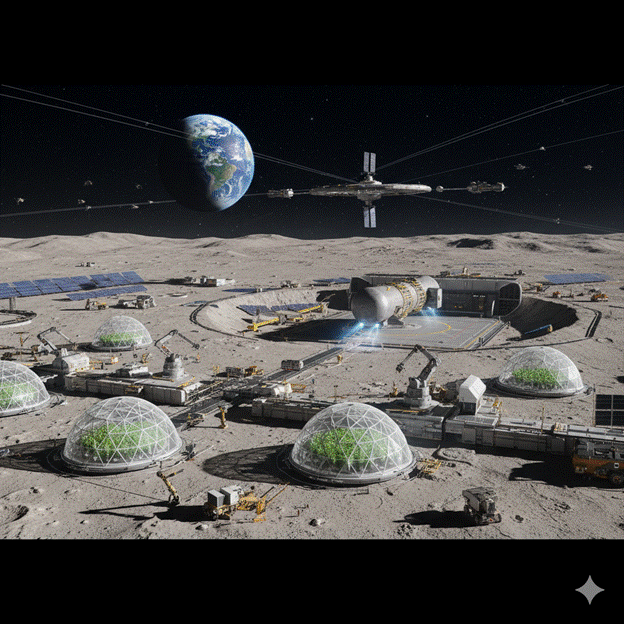
We provide Automated Greenhouse Modules designed to maximize
psychological well-being. By integrating vertical farming with biophilic
•
•
•
design, our solutions offer crews fresh nutrition and a visual connection to
terrestrial nature, critical for long-duration lunar and deep-space missions.
II. Intelligent Spatial Management
Leveraging Decision-Intelligence, we design adaptive interiors. Using Edge
Computing and sensor arrays, our modules can automatically reconfigure
lighting and acoustic profiles to distinguish between “work” and “rest”
cycles, mitigating the circadian rhythm disruptions common in orbital
environments.
III. Radiation-Safe Communal Hubs
Our architectural frameworks utilize Graphene-Mediator Hulls specifically
for communal areas. By prioritizing these “shielded sanctuaries,” we ensure
that gathering points (kitchens and exercise areas) provide the highest level
of safety from solar particle events without adding excessive mass to the
entire station.
IV. Low-Latency Social Connectivity
To address the psychological toll of distance, we utilize Next-Gen Optical
Connectivity. Our high-bandwidth laser links enable “Real-Presence”
communication, allowing crews on the Lunar Gateway to maintain highdefinition, low-latency social connections with Earth. - Conclusion: The Thriving Frontier
Life in space is an ongoing experiment in human adaptability. Through the
integration of biophilic engineering, intelligent automation, and advanced
shielding, Aliens R&D is transforming the “extreme environment” into a
sustainable home for the next generation of space explorers.