ALIENS R&D ENGINEERING OVERVIEW | 2026
The traditional “launch-to-deploy” model is a fundamental constraint on humanity’s
expansion into the cosmos. At Aliens R&D, we are shifting the focus toward InSpace Servicing, Assembly, and Manufacturing (ISAM). By shifting production to
the orbital environment, we bypass the volume limitations of fairings and the
structural stresses of high-G launches.
- Orbital Assembly & Structural Robotics
Large-scale infrastructure, such as solar power satellites and long-distance transit
vehicles, cannot be launched in a single piece. Our research focuses on highprecision robotic assembly systems.
Autonomous Robotic Arms (ARA)
We are developing multi-jointed robotic manipulators equipped with tactile feedback
sensors. These systems are designed for Autonomous Orbital Berthing—the
ability to capture, dock, and assemble modular components with millimeter precision
in microgravity.
Swarm Robotics for Modular Construction
Instead of a single large machine, we utilize swarms of smaller, specialized robots.
These “agents” work in coordination to build complex trusses and shielding,
providing redundancy and scalability for large-scale lunar and orbital habitats.
Key Innovation: Persistent Orbital Platforms that serve as “Space Factories,”
capable of repairing and upgrading existing satellite constellations without
ground intervention. - Additive Manufacturing & ISRU Integration
The cost of transporting raw materials from Earth remains a barrier. Our R&D
integrates 3D printing with In-Situ Resource Utilization (ISRU).
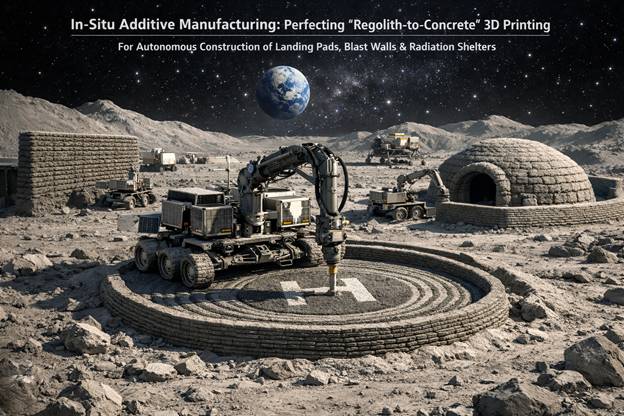
Regolith Processing: Developing extrusion technologies that can transform
lunar or asteroid regolith into structural “bricks” or shielding layers.
Recyclable Polymers: Creating a circular economy in space by repurposing
decommissioned satellite hulls and transit waste into high-quality feedstock for
3D printers.
Microgravity Metal Sintering: Utilizing laser-based sintering to manufacture
high-strength engine components and tools directly in orbit. - Satellite Life Extension & Refueling
Currently, a satellite’s lifespan is limited by its fuel capacity. Aliens R&D is
engineering the robotics required for On-Orbit Refueling.
Our robotic tankers utilize standardized docking interfaces to transfer cryogenic
propellants. This “Gas Station in Orbit” approach effectively doubles the operational
life of multi-billion dollar assets, drastically improving the ROI for space
infrastructure. - The Future: A Self-Sustaining Orbital Economy
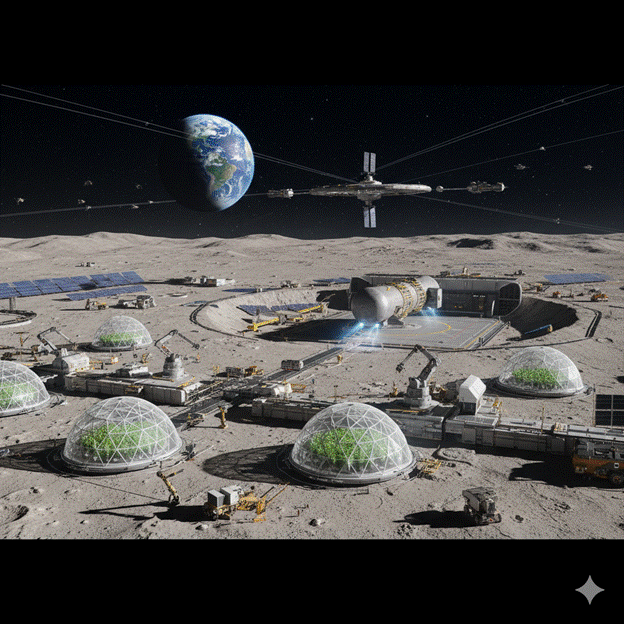
By 2030, we envision a space sector where the majority of hardware is “Born in
Space.” This transition is powered by robotics that can think, act, and build without
the 2-second latency of Earth-based control. Aliens R&D is building the hands and
minds of this new industrial revolution